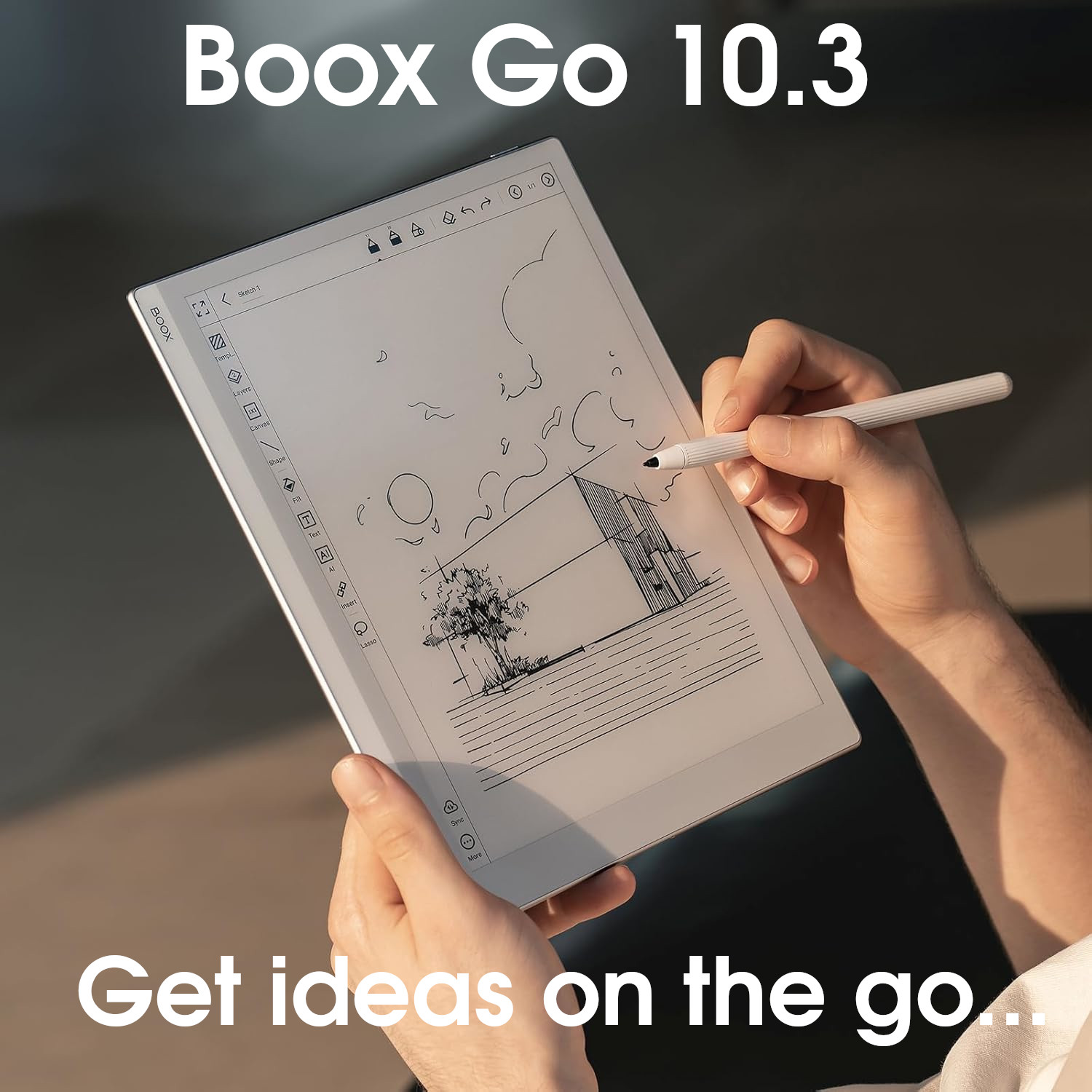

Not too long ago, all the top e-ink tablets used a single stylus input technology (Wacom EMR), but in 2024, reMarkable bucked the trend by using an Active Pen with the reMarkable Paper Pro. And in 2025, Boox followed suit with their InkSense and InkSpire styluses (which are also Active Pens).
So I thought it would be useful to write a quick article to briefly discuss the differences between these two technologies.
TRANSPARENCY NOTICE: I much prefer EMR Pens to Active Pens because I find it to be a superior technology – although I will try to be objective, I felt I should point this out from the outset, in case any personal bias creeps into this article.
I should also note that although I have used several e-ink tablets with Active Pens (reMarkable Paper Pro, Boox Tab X, Boox Go 7 and Go Color 7, Bigme B7, Kobo Elipsa, Kobo Libra Color) and even more e-ink tablets using EMR (too many to list), I would not call myself an expert on these stylus input technologies. However, I feel I have used enough devices to draw generalisations about them, and personally I feel that EMR is better.
Capacitive Stylus
Before exploring EMR and Active Stylus tech, I want to quickly mention capacitive stylus tech.
A capacitive stylus simply acts like a faux fingertip is touching the screen. If you can draw on a screen with your finger, then you can draw on it with a capacitive stylus – it just gives you more of a finer tip, and sometimes a bit more friction to make it more comfortable/precise when creating strokes. It doesn’t require any additional technology (other than the touchscreen itself).
Although most e-ink tablets have touchscreens as standard (for tapping on icons etc.) I don’t know of any that use this as their main form of stylus input It is possible to use a capacitive stylus instead of your finger on an e-ink tablet in certain 3rd-party apps, but it usually won’t work with the native note-taking app. Instead, a more sophisticated technology is used that provides better accuracy, less lag, and higher performance. In addition, they usually provide extra features such as pressure/tilt sensitivity, eraser, and palm rejection.
And the two main contenders are Active Pens and Wacom EMR styluses.
Active Pen Stylus
Active Pens build on the existing touchscreen technology but also emit electrical signals that are picked up and decoded by the tablet. They communicate with the tablet using proprietary protocols, which include Microsoft’s MPP (used by Kobo tablets), Intel’s USI (used by the reMarkable Paper Pro, Boox Inkspire/InkSense, Bigme), Wacom AES (which is different to Wacom EMR), and Apple Pen.
Although all Active Pens use the same underlying technology (and could – in theory – be cross compatible), the reality is that there are just enough differences between them to make them incompatible. For example, Kobo Pens that use MPP won’t work with devices that use USI (such as the rMPP, Boox or Bigme) and vice versa.
Furthermore, although the USI Active Pens do technically ‘work‘ across the different brands (e.g. the rMPP Pen ‘works‘ on the Boox Tab X/Go 7/Go Color 7 and vice versa), the performance and tactile feel is very poor. You can make pen strokes on the screen but the lines might look shaky or there may be too much/too little friction. Sometimes strokes may be missed or the stylus will stop working completely. In general, it just doesn’t look or feel very nice.
The images below show the writing on four different e-ink tablets using 4 different USI Active Pens.


This is because each pen has been optimised to work well with the tablet it has been designed for and nothing else. Basically, what I’m saying is that you should only really use an Active Pen designed specifically for a certain tablet. Just because an Active Pen uses the same protocol as the tablet, it does not necessarily mean that using it will be a nice writing experience.
Active Pens require their own power source in the form of a battery within the shaft of the stylus. Sometimes this can be an actual AAAA barrel battery, but these days, it is usually a smaller, non-swappable, rechargeable lithium battery. The two main methods of recharging said battery are wireless charging (by magnetically snapping the stylus to the side of the tablet) or via a USB-C port.
Depending on the technology/protocol used, Active Pens can also offer several levels of pressure sensitivity and tilt sensitivity, as well as extra features like button customization and eraser.
EMR Stylus
EMR stands for Electro-Magnetic Resonance and this stylus technology was developed by Wacom.
It uses a magnetic field generated by the tablet to power the stylus, and therefore EMR Styluses do not need batteries (or require charging).
Wacom also offers the same extra features as Active Pens (pressure/tilt sensitivity, eraser, etc.)
There is also a lot more compatibility between products that use Wacom EMR technology. EMR styluses for the reMarkable 2, Boox, Bigme, Viwoods etc. are all interchangeable, and third-party EMR styluses should also work fine with most e-ink tablets.
Subjectively (to me, anyway), Wacom EMR styluses feel much more natural and precise.
Summary
To me, Wacom EMR is still the gold standard of stylus input technology, and there are several reasons for this.
Firstly, EMR styluses have no battery and do not have to be recharged. Of course it’s no great hardship to recharge a stylus, particularly if wireless charging is supported, but it is far more convenient to not have to remember to do so at all. And (eventually) that internal battery is going to die, and in most cases they can’t be replaced, so it means buying a new stylus.
EMR styluses usually have a finer point on the nib, which makes them more precise. In contrast many (not all) Active Pens have a wider cone-shaped nib that looks like a crayon. In addition, the nibs of Active pens are usually smoother and hard, which results in more of a tapping noise and less friction when writing.

Having said that, the nibs on Active Pens do tend to last longer because they don’t wear down as fast. And they leave less debris (tiny bits of worn off nib) on the screen (but this is something you would only notice with EMR styluses if you were doing a lot of shading/colouring).
Overall, there is nothing inherently wrong with Active Pens – they do the job of mark-making absolutely fine – but, to me, EMR has a much more refined feel, and is more convenient (because it doesn’t require recharging).