
Introduction
I wrote this article to try and demystify the world of e-readers by providing a plain-speaking, yet comprehensive guide.
So if you’re looking to buy an e-reader but don’t quite understand your Kindles from your Kobos, or your ePubs from your PDFs, this guide is just for you.
What Is an E-Reader?
An e-reader – sometimes referred to as an electronic reading device – is a specialised handheld apparatus designed primarily, and in many cases exclusively, for the consumption of digital textual materials. Unlike multipurpose tablets or smartphones, which function as generalised computing platforms, the e-reader is a device with a narrow remit: it exists fundamentally to replicate, and in certain respects to transcend, the experience of reading printed literature, documentation, and long-form prose.
At the core of virtually all contemporary e-readers is E-Ink display technology, a reflective screen system that mimics the optical qualities of paper by relying on ambient light rather than internal illumination. This attribute confers several consequential advantages: markedly reduced eye strain compared with emissive LCD or OLED panels; exceptional energy frugality, permitting weeks (or even months) of operation on a single charge; and high legibility under intense sunlight or other bright environmental conditions. Many modern devices supplement this with a front-lighting array – positioned above the display rather than behind it – which provides controllable illumination without undermining the fundamentally paper-like character of the screen.
Crucially, e-readers are engineered around the behavioural patterns of dedicated readers. Their interfaces are generally uncluttered, the operating systems simplified, and their performance optimised not for speed or multimedia prowess (although that line has blurred somewhat in recent years) but for stability, consistency, and protracted reading sessions. In contrast with conventional tablets, they tend not to support a broad universe of applications, prioritising instead a coherent and distraction-free environment in which the text itself occupies primacy.
E-readers typically support a variety of digital book formats, enabling the storage of entire libraries within a device that weighs scarcely more than a slim paperback. Features such as adjustable typography, built-in dictionaries, annotation tools, and synchronisation across devices further enrich the reading experience without departing from the central ethos of quietude and immersion. For many readers, this synthesis of portability, endurance, and typographical flexibility renders the e-reader a compelling adjunct – or, in some cases, a complete replacement – for physical books.
In essence, an e-reader is not merely a miniature computer with a book-shaped interface; it is a deliberately constrained, purpose-built instrument whose design aims to preserve the contemplative nature of reading while exploiting the affordances of modern digital technology. It occupies a distinctive niche within the wider landscape of personal electronics, prioritising cognitive focus and ergonomics over the maximalist functionality that characterises multifunction devices.
Benefits of E-Ink Devices vs Tablets and Smartphones
Although tablets and smartphones are capable of displaying textual material with great clarity, the ontology of these devices is fundamentally different from that of the dedicated e-reader. Their design priorities – multimedia consumption, rapid interaction, and perpetual connectivity – are not always consonant with the prolonged, immersive engagement that typifies serious reading. E-readers, by contrast, are engineered around a set of principles that privilege attentiveness, visual comfort, and long-term usability.
The most conspicuous advantage arises from the E-Ink display itself. Because E Ink screens are reflective rather than emissive, they do not bombard the eyes with luminance in the manner of LED-based tablets. Instead, they behave more like paper, relying on ambient light to render text. This produces a markedly reduced level of ocular fatigue, particularly during extended reading sessions, and is often experienced as calmer or gentler on one’s visual faculties. The absence of glare and the high contrast ratio under strong sunlight further reinforce their suitability for outdoor use, where conventional screens frequently falter.
Battery longevity constitutes a second, and frequently underestimated, benefit. Tablets and smartphones must power bright displays and numerous background processes, leading to operational lifespans measured in hours. E-readers, by contrast, consume energy only when refreshing the screen or performing modest computational tasks. Consequently, many users enjoy multiple weeks of reading from a single charge – an attribute that dramatically lowers friction, reduces the psychological burden of battery management, and preserves the sense of dependability traditionally associated with printed media.
Equally important is the cognitive environment that e-readers foster. Multifunction devices are inherently distractible: notifications, social media, message alerts, and a panoply of interactive applications constantly compete for attention. Even with disciplined self-regulation, the mere availability of these diversions introduces a latent cognitive noise that undermines deep reading. E-readers (in general), by virtue of their constrained functionality, cultivate a more monastic digital space, insulated from interruptions. The intentional absence of non-reading apps is not a deficiency but an architectural virtue, encouraging uninterrupted focus and enhancing comprehension.
Additionally, e-readers frequently offer a superior ergonomic profile for sustained use. Their lightweight construction, textured surfaces, and often asymmetrical designs make them comfortable to hold for prolonged periods, whereas tablets – especially larger models – can become fatiguing. The typography controls, such as adjustable font sizes, line spacing, and margins, further tailor the reading environment to individual preferences, something that printed books cannot accommodate and tablets rarely prioritise.
In summary, while tablets and smartphones offer impressive versatility, the strengths of e-readers lie precisely in their specialisation. They provide a visually soothing, distraction-free, energy-efficient medium for textual engagement, making them uniquely suited to readers who value depth, comfort, and continuity over the kaleidoscopic functionality of general-purpose devices.
What This Guide Covers
The purpose of this guide is to furnish the prospective e-reader purchaser – or the intellectually curious reader – with a comprehensive, methodical exposition of the considerations that attend the selection of an e-reading device. The contemporary e-reader landscape, though ostensibly straightforward, is in fact a complex confluence of software ecosystems, hardware idiosyncrasies, proprietary standards, and divergent philosophies of design. This guide seeks to disentangle these elements and present them in a manner both analytically rigorous and practically instructive.
To that end, the ensuing sections will examine, first, the file formats that underpin digital reading, with particular emphasis on the distinctions between EPUB, PDF, and their various derivatives. Because file compatibility has profound implications for usability, device longevity, and reading flexibility, an informed understanding of these formats is indispensable.
We shall then explore the often opaque realm of Digital Rights Management (DRM), whose mechanisms determine the movement, storage, and long-term accessibility of purchased eBooks. Given that DRM constraints vary significantly between platforms – most notably between Amazon’s Kindle system and the Adobe-managed ecosystem used by many competing manufacturers – this section provides the conceptual groundwork for appreciating the broader implications of choosing one ecosystem over another.
The guide also surveys the channels through which eBooks may be acquired, from major commercial retailers to independent stores, as well as sources of public-domain literature. Because purchasing habits inevitably shape device experience, this discussion aims to equip the reader with a realistic expectation of what ownership entails.
Subsequent sections provide a systematic overview of the principal e-reader brands and ecosystems (Kindle, Kobo, PocketBook, and Android-based models) evaluating their respective strengths, limitations, and software characteristics. Thereafter, a detailed analysis of hardware attributes is offered, encompassing screen technologies, lighting systems, ergonomics, storage, and auxiliary features.
Finally, the guide concludes with a synthesising summary, distilling the central insights and articulating the key principles that should guide an informed purchasing decision.
In aggregate, this guide endeavours not merely to enumerate features but to cultivate a nuanced appreciation of how these devices function, what differentiates one model from another, and how each aligns with distinct patterns of reading behaviour. Its ambition is to provide clarity within a domain often clouded by marketing rhetoric and fragmented information, enabling readers to navigate the e-reader landscape with confidence and discernment.
Understanding eBook File Formats
eBook file formats are essentially the digital versions of a book’s structure, determining how the text is stored, displayed, and organised on an e-reader. Just as a printed book’s layout and binding affect how you read it, these formats shape everything from how the pages appear to whether the text can resize smoothly.
EPUB
EPUB is the predominant open standard for digital books and functions as the backbone of most non-Amazon e-reading ecosystems. At its essence, an EPUB file is a structured collection of XHTML, CSS, images, and metadata, bundled together in a manner that allows the text to reflow – that is, adjust itself dynamically to different screen sizes, font choices, and layout preferences. This reflowable nature makes EPUB exceptionally well suited to e-readers, enabling a level of typographic flexibility that printed books cannot replicate.
One of the chief virtues of the EPUB format is its interoperability. Because it is maintained by the World Wide Web Consortium (W3C) and intended as an open, vendor-neutral standard, EPUB files can be used across a broad range of devices – including Kobo, PocketBook, and most Android-based e-readers – without locking the reader into a single retailer or ecosystem. Even when DRM is applied, it typically follows the Adobe Digital Editions system rather than a wholly proprietary scheme, preserving a measure of cross-platform compatibility.
Sidenote: Technically, Kindle e-readers do support EPUBs, but not natively – essentially, you can send an EPUB to your Kindle to read, but during the transfer process through Amazon’s servers it undergoes a conversion into an Amazon proprietary file format (KFX).
EPUB also supports an array of modern features, such as embedded fonts, advanced styling, internal navigation, and accessibility enhancements. These capabilities contribute to a more refined reading experience and make the format adaptable to both simple novels and more complex texts, such as academic works or technical manuals.
In practice, choosing a device that supports EPUB affords the user greater freedom in sourcing eBooks and a higher likelihood of long-term accessibility. For many readers – particularly those who wish to avoid ecosystem lock-in – EPUB represents the most versatile and future-resilient format currently available.
The Portable Document Format (PDF) occupies a distinctive position within the ecosystem of digital reading. Unlike EPUB and other reflowable formats, a PDF is fundamentally a fixed-layout document: each page is designed with precise spatial relationships between text, images, and margins, preserving the exact appearance intended by the creator. This makes PDFs invaluable for materials where layout is integral – academic papers, textbooks, technical manuals, forms, and documents containing complex diagrams or tables.
However, this very rigidity becomes problematic on e-readers, particularly those with smaller screens. Because the page cannot easily reshape itself to fit varying display sizes, reading a PDF on a 6- or 7-inch e-reader often necessitates frequent zooming, panning, and manual adjustment. These interactions can interrupt the flow of reading and, on devices with slower refresh rates, feel ponderous. Larger e-readers mitigate the issue somewhat, but even then, the experience may lack the smoothness associated with reflowable text.
PDFs also tend to be computationally heavier than EPUBs. Rendering a detailed page – especially one containing images or multi-column layouts – requires more processing power and can slow down page turns. Annotation tools, while available on many devices, may likewise feel less agile compared with their behaviour in dedicated PDF applications on tablets or computers.
Nevertheless, PDFs remain indispensable for readers whose materials demand precise formatting. They guarantee fidelity to the original document, ensuring that diagrams align correctly, fonts remain consistent, and the visual structure is preserved. For anyone whose reading encompasses academic literature or professional documentation, PDF support is therefore an essential, albeit sometimes imperfect, component of the e-reader experience.
Personally, I feel that if your reading materials primarily consist of PDFs it is much better to get a device with a bigger e-ink screen (at least 10″) because the reading experience is far more comfortable. Unfortunately, I’ve seen very few dedicated e-readers with larger screens – instead, this is more the realm of e-ink tablets (which are very similar to e-readers but also have note-taking/handwriting support).
Other Formats
Beyond EPUB and PDF, a number of additional file formats occupy various niches within the digital reading landscape. Some persist for historical reasons, while others serve specialised purposes that continue to resonate with particular reading communities.
MOBI, for instance, is a legacy format once widely used on early Kindle devices. Although Amazon has largely superseded it with its more modern AZW and KFX formats, MOBI files remain in circulation, especially among readers who use older devices or personal libraries accumulated over many years. MOBI’s capabilities are comparatively limited – its styling is rudimentary and its support for advanced layout features is minimal – but its persistence reflects Kindle’s long-standing influence on the e-reading ecosystem.
In contrast, plain text (TXT) files represent the most stripped-down form of digital reading. They contain unformatted text without embedded images, styling, or metadata. While aesthetically spartan, TXT files offer unmatched simplicity, microscopic file sizes, and near-universal compatibility. They are sensible for older literature, personal notes, or any context where the content itself matters more than its typographical presentation.
Specialised formats such as CBR and CBZ are widely used for digital comics and graphic novels. These are essentially compressed image archives, presenting each page as an image rather than reflowable text. On e-readers – especially monochrome ones – the experience can be variable: while some devices handle high-resolution comic pages competently, others struggle with slow rendering or insufficient screen size. Colour e-readers improve matters (but also have drawbacks – see below), but still cannot rival the vibrancy of modern tablets.
A handful of other formats – such as HTML, RTF, and DOCX – may be readable on certain devices, though often with inconsistent results. Their support tends to be an ancillary feature rather than a core part of the reading experience.
Taken together, these formats illustrate the multiplicity of ways text can be encoded and displayed. While EPUB and PDF dominate modern e-reading, awareness of these ancillary formats is useful, particularly for readers with diverse content sources or long-standing personal archives.
How File Format Support Differs Across E-Reader Brands
File format compatibility varies considerably between e-reader manufacturers, and these differences have substantial consequences for how easily users can source, transfer, and manage their digital libraries. Although many devices share broad similarities, the philosophical approach each brand adopts toward openness or proprietary control profoundly shapes the reader’s experience.
Amazon’s Kindle ecosystem is the most restrictive in this regard. Kindles primarily support Amazon’s own AZW and KFX formats, with partial support for older MOBI files. While modern Kindles can accept EPUB files via Amazon’s conversion process, they do not natively read EPUB in its original form, and the conversion pipeline itself maintains Amazon’s overarching ecosystem lock-in. This approach ensures tight integration with the Kindle Store but limits the user’s ability to import books purchased from other retailers or freely downloaded in open formats.
By contrast, Kobo devices are built around EPUB compatibility, embracing it as their principal format. They support both DRM-free and Adobe DRM–protected (see below) EPUB files, as well as PDFs and some secondary formats. This openness affords Kobo users significantly greater flexibility in choosing where to acquire their eBooks, making the Kobo ecosystem more porous and adaptable than Amazon’s. The same general philosophy extends to PocketBook, which supports a wide array of file formats, including ADE DRM-Protection.
Android-based e-readers, such as those produced by Boox and Bigme, offer the broadest compatibility of all, not just because of native support for numerous formats but also because they can run third-party applications. This means that virtually any format supported by an Android reading app can be accessed, although the quality of the experience may depend on the optimisation of the software rather than the device itself. For example, you can install the Kindle app on an Android e-reader to access ebooks from your Kindle library.
These divergences in format support are not trivial technicalities – they determine how freely a reader can curate their library, whether they are beholden to a single retailer, and how easily they can move between devices. Understanding these distinctions is therefore essential when choosing an e-reader that aligns with both present reading habits and long-term preferences.
DRM (Digital Rights Management) Explained
Digital Rights Management (DRM) refers to a suite of technological measures designed to control how digital content – such as eBooks – is accessed, copied, transferred, or shared. At its core, DRM functions as a system of permissions and restrictions, embedded within the file itself or enforced through the software and servers that deliver it. When you purchase a DRM-protected eBook, you are not acquiring unrestricted ownership of a digital file; rather, you are receiving a licensed right to read it under conditions defined by the publisher or retailer.
The rationale behind DRM is rooted in concerns about copyright protection and the perceived ease with which digital files can be duplicated. Publishers and retailers employ these mechanisms to prevent unauthorised distribution, ensure that revenue flows back to rights holders, and preserve the commercial viability of digital publishing. Whether DRM achieves these goals effectively is a matter of ongoing debate, but its presence remains a defining characteristic of mainstream eBook markets.
From a reader’s perspective, DRM shapes what can and cannot be done with an eBook: whether it can be transferred to another device, backed up independently, loaned to another user, or read on competing platforms. These constraints vary significantly between ecosystems, which is why understanding DRM is crucial when selecting an e-reader. The choice of device – in practical terms – determines not merely the hardware you will use but also the legal and technical boundaries within which your digital library will operate.
Kindle DRM
Amazon’s Kindle platform relies on a proprietary DRM system that integrates tightly with its own file formats – principally AZW and the more advanced KFX. These formats are engineered to work seamlessly within the Kindle ecosystem, enabling features such as synchronised reading progress, enhanced typesetting, and cloud-based library management. However, their functionality is inseparable from Amazon’s broader strategy of maintaining a closed, self-contained environment in which content is purchased, stored, and consumed under Amazon’s oversight.
From a technical perspective, Kindle DRM encrypts purchased eBooks such that they can be opened only on registered Kindle devices or within authorised Kindle apps. This encryption binds each eBook to the user’s Amazon account, not to the device itself, ensuring that Amazon remains the intermediary through which access is granted or revoked. While this system offers streamlined convenience – books appear automatically across devices, and user annotations synchronise effortlessly – it means that Kindle users cannot freely transfer DRM-protected files outside the ecosystem or read them on competing e-readers.
KFX, Amazon’s newer format, reinforces this dependency further. It introduces sophisticated layout and rendering capabilities, but its internal structure is opaque, and its DRM is difficult to circumvent or convert. This deepens the practical lock-in: once a reader’s library is extensively populated with KFX titles, moving to a different platform becomes considerably more challenging.
The result is a trade-off between convenience and autonomy. The Kindle ecosystem excels in frictionless purchasing, reliable syncing, and robust customer support, but these advantages are balanced by reduced portability of one’s digital library. Readers considering a Kindle should be aware that their long-term freedom to migrate away from Amazon – or to use their books across a variety of devices – may be materially constrained by the very DRM mechanisms that make the system function so smoothly.
Adobe DRM (ADE)
While Amazon employs its own proprietary system, many other e-reader manufacturers (including Kobo, PocketBook, and numerous independent booksellers) rely on Adobe Digital Editions (ADE) as their primary DRM framework. Adobe DRM functions as a kind of industry-standard licensing layer for EPUB and PDF files, allowing publishers to protect their content without tethering it to any single hardware brand or retail platform.
In practical terms, an ADE-protected eBook is encrypted but can be read on any device or application that supports Adobe’s authentication system. This creates an ecosystem that is far more interoperable than Amazon’s: a book purchased from one ADE-compatible retailer can typically be transferred to another ADE-compatible e-reader, provided the user’s Adobe ID remains consistent across devices. Although the process is not always seamless – it often requires the user to sideload files via a computer – this cross-platform compatibility affords readers something closer to genuine ownership.
That said, Adobe DRM is not without its irritations. The system relies on periodic server authentication, meaning that access to purchased titles may require an active Adobe account and, in rare cases, a functioning connection to Adobe’s servers. Users sometimes encounter issues when authorising devices, especially if they have exceeded the number of concurrent activations permitted by Adobe’s device limit policy. These inconveniences can undermine the theoretical openness of the system, introducing bureaucratic friction into what should be a straightforward reading experience.
Nevertheless, Adobe DRM occupies a middle ground in the digital reading landscape. It imposes restrictions, but not proprietary confinement; it protects publisher interests without wholly sacrificing reader autonomy; and it allows for a genuinely multi-brand ecosystem in which Kobo, PocketBook, and various apps coexist. For readers who prefer flexibility in sourcing their books (or who wish to avoid the singular dependence that Amazon’s ecosystem entails), ADE-based DRM represents a pragmatic, if occasionally inelegant, solution.
DRM-Free eBooks
In contrast to the restrictions imposed by proprietary or Adobe-based systems, DRM-free eBooks grant readers a level of autonomy more closely aligned with traditional notions of ownership. A DRM-free file -whether EPUB, PDF, or another format – can be copied, backed up, transferred between devices, or archived indefinitely without requiring permission from an external server or adherence to a prescribed ecosystem. This freedom imbues digital books with a form of permanence and portability that more closely resembles their printed counterparts.
The appeal of DRM-free content lies not only in its flexibility but also in its implications for longevity and preservation. Because the file is not tethered to a particular vendor or reliant on authentication systems that may change or disappear, the reader retains direct control over their library. This ensures that eBooks remain accessible even if a device is replaced, a retailer ceases trading, or a platform undergoes structural changes. Such stability is particularly attractive to readers who build large collections, value digital archiving, or prefer to avoid reliance on corporate infrastructure.
Many independent publishers, niche retailers, and public-domain projects distribute their works without DRM. These include sources such as Standard Ebooks, Project Gutenberg, and a variety of smaller presses that view DRM as philosophically antithetical to the free exchange of literature. Several mainstream publishers have also experimented with DRM-free releases, recognising that restrictions often burden legitimate readers more than they deter illicit distribution.
However, while DRM-free eBooks offer clear advantages, they also place greater responsibility on the reader. Without an automated storefront or cloud system enforcing structure, readers must manage their own backups and organisation. For some, this is a welcome freedom; for others, it may feel like an additional task.
The titles you can obtain in a DRM-free format are also limited. Whilst there is wide availability of classics for which the copyright has expired, you cannot expect to get the latest bestsellers (or indeed anything with inherent value less than 70 years old) with the DRM removed (at least not legally).
Ultimately, DRM-free eBooks provide the most reader-centric model within the digital publishing landscape – one that emphasises control, longevity, and interoperability over constraint or convenience.
A Brief Note on DRM Removal (e.g., Calibre Plugins)
No discussion of DRM would be complete without acknowledging the existence of tools that allow readers to circumvent or remove DRM from their purchased eBooks. The most widely known of these are user-created plugins for the open-source library management software Calibre, which can, under certain conditions, strip DRM from files to permit format conversion, offline backups, or migration between ecosystems. These tools are frequently referenced in digital reading communities because they address many of the practical frustrations associated with restrictive DRM systems.
However, it is essential to emphasise that the legal status of DRM removal varies significantly across jurisdictions. In many countries, breaking DRM – whether or not one has legally purchased the content – may contravene copyright law or specific anti-circumvention provisions. Even where such actions are not rigorously enforced, they often fall into a regulatory grey area that warrants caution and informed judgement.
From a reader’s perspective, the interest in DRM removal typically stems not from an intention to distribute content unlawfully, but from a desire to exercise fuller control over legitimately acquired books. Readers may wish to convert a Kindle book into EPUB for use on a different device, preserve access to titles should a service terminate, or maintain a unified personal archive. These motivations arise from perfectly reasonable concerns about long-term accessibility and ownership.
Nevertheless, this guide does not provide instructions for bypassing DRM, nor does it advocate doing so. The topic is acknowledged here solely because it is a significant and widely discussed aspect of contemporary e-reading culture. Readers are encouraged to familiarise themselves with the laws applicable in their region and to weigh the ethical and practical considerations carefully before engaging with such tools.
Summary of DRM methods
To summarise:
- Ebooks using Kindle DRM can only be read on Kindle e-readers or via the Kindle software app (so Android e-readers can read Kindle ebooks by installing the Kindle App)
- Ebooks using ADE DRM can be read on e-readers that support ADE (e.g Kobo, Pocketbook etc.)
- Ebooks without DRM can be read on any e-reading device (although with Kindle devices, the file is converted into Kindle’s proprietary format during transfer)
Buying and Finding eBooks
Readers today can obtain eBooks from an exceptionally broad range of sources, each with its own advantages, limitations, and underlying philosophies. Commercial retailers such as Amazon and Kobo offer extensive catalogues and integrated purchasing systems, while independent bookstores and niche publishers provide alternatives that often prioritise openness or DRM-free access. Public-domain repositories supply freely available classics, and library lending services allow temporary access to contemporary titles at no cost. The landscape is thus a mixture of proprietary ecosystems, interoperable platforms, and freely accessible archives, and understanding their differences is essential for navigating the digital reading world with confidence and flexibility.
Amazon Kindle Store
The Amazon Kindle Store is the single largest retailer of eBooks, offering an expansive catalogue that spans popular fiction, academic works, niche genres, self-published material, and everything in between. Its principal attraction lies in the extraordinary convenience it affords: books can be purchased with minimal friction and delivered instantaneously to any device or app registered to the user’s Amazon account. Features such as whisper-syncing, one-click purchasing, and integrated recommendations further streamline the process, creating a cohesive and highly accessible ecosystem.
However, this convenience is inseparable from a structural lock-in inherent to the Kindle platform. The majority of titles purchased through Amazon are encumbered with proprietary DRM, binding them to the Kindle environment and preventing straightforward transfer to non-Kindle devices. Even where Amazon accepts external file formats, the the original format is often converted into a proprietary Kindle format. As a result, users who accumulate substantial libraries within the Kindle Store may find it increasingly difficult to transition to alternative e-reading platforms without losing access to purchased content or resorting to technically complex workarounds.
The Kindle Store also privileges Amazon’s own digital architecture, meaning that readers are effectively participating in a vertically integrated ecosystem where retailer, distributor, and platform are all the same entity. For many, this arrangement is acceptable – reliable syncing, cloud storage, and device management can be reassuringly seamless. Yet for others, particularly those who value portability, independence, or long-term archival control, the dependence on Amazon’s infrastructure may be a cause for hesitancy.
In short, the Kindle Store excels at offering a frictionless, highly curated, and technically polished purchasing experience, but it does so by embedding the reader firmly within Amazon’s closed ecosystem. This trade-off is crucial to understand when deciding whether a Kindle is the right long-term choice.
Kobo Store and Other ADE-Compatible Bookstores
In contrast to Amazon’s closed ecosystem, the Kobo Store and other retailers that utilise Adobe Digital Editions (ADE) offer a more open and interoperable model for acquiring eBooks. Kobo’s catalogue is extensive – comparable in breadth to Amazon’s – and includes mainstream fiction, non-fiction, academic titles, and a notable selection of independent and international works. Purchases made through Kobo can be read on Kobo devices, in the Kobo app, or downloaded as Adobe DRM–protected EPUB files for use on a wide variety of compatible e-readers.
This reliance on the EPUB standard confers a significant degree of portability. A book purchased from the Kobo Store can typically be transferred to any device authorised with the same Adobe ID, whether made by Kobo, PocketBook, or another manufacturer. Although the process sometimes involves sideloading through a computer – less instantaneous than Amazon’s wireless delivery – it grants readers a level of choice and flexibility not found in more restrictive ecosystems.
However, it should be noted that ebooks purchased directly from Kobo will seamlessly download onto the user’s Kobo e-reader (it is only when purchasing an ADE ebook from a third-party supplier or wanting to read an ADE ebook purchased from Kobo on another brand of e-reader that the hassle of side-loading comes into play).
Other ADE-compatible bookstores operate on similar principles. Retailers such as Google Play Books, Barnes & Noble’s Nook Store (in certain regions), and various independent eBook shops all distribute titles in formats that can be used across multiple platforms. This creates a loosely federated ecosystem, unified not by a single corporation but by shared technical standards. Readers are not obliged to remain loyal to any individual retailer (as they are with the Kindle ecosystem) and can cross-shop for better prices, regional availability, or DRM-free alternatives where offered.
The trade-off is that these retailers often lack the tightly integrated convenience of Amazon’s infrastructure. Syncing may require more manual involvement, and the user experience can vary between platforms. Nonetheless, for readers who prioritise interoperability, openness, and long-term control over their digital libraries, the ADE-based model represents a compelling alternative.
Bookstores With Proprietary Reading Apps
A number of eBook retailers occupy an intermediate position between the tightly controlled Kindle ecosystem and the open, ADE-based model. These are bookstores that distribute their titles primarily through own proprietary reading apps (often designed for mobile devices rather than dedicated e-readers). Examples include Apple Books, Barnes & Noble’s Nook app (distinct from its hardware ecosystem), and various regional or niche digital booksellers.
These platforms typically offer a polished, user-friendly reading experience within their own apps, complete with features such as synchronised bookmarks, attractive typography, and integrated purchase flows. Because the apps run on smartphones and tablets, they benefit from high-quality colour displays, fast processors, and mature annotation tools – attributes that many e-readers do not fully emulate. For users already accustomed to reading on multifunction devices, these apps can feel familiar and convenient.
However, the proprietary nature of these systems introduces limitations. Books purchased through such platforms often cannot be exported as standard EPUB or PDF files, meaning the reader is effectively tied to the app/brand that provided them. Unlike ADE-compatible titles, which can migrate between devices, proprietary app-based books remain confined to environments controlled by the retailer. This model resembles Kindle’s lock-in, though it is generally less prominent because the content is aimed at users who already view reading as one function among many on their primary device.
Moreover, these apps rarely coexist with dedicated e-reader hardware. Since most of them do not develop their own E Ink devices – and do not typically license their platforms to manufacturers – readers who wish to migrate from phone or tablet reading to an e-reader may find that their existing libraries do not transfer easily.
However, in recent years, more and more Android e-readers have become available on the market, which support the installation of apps from the Google Play Store, just as you might with your phone or tablet. This means it is possible to install third-party reading apps, such as those offered by bookstores (it is also worth noting that both Kindle and Kobo provide their own Android reading apps to access their respective libraries on any Android device, including e-readers).
In essence, bookstores with proprietary reading apps offer a well-integrated but self-contained digital reading experience. They are ideal for those who do not anticipate leaving the mobile ecosystem, but they offer limited freedom for readers who prefer a dedicated e-reader or who wish to maintain long-term, device-agnostic control of their eBook collection.
Free and Public Domain Sources
Beyond commercial bookstores, a rich and ever-expanding array of public domain and freely accessible eBook sources provides readers with cost-free access to thousands of classic works, historical texts, and culturally significant literature. These repositories operate outside the constraints of DRM and proprietary ecosystems, offering files – usually in EPUB, PDF, or plain text – that can be copied, shared, and archived with complete freedom.
The most renowned of these is Project Gutenberg, a longstanding volunteer-driven initiative that has digitised and made available tens of thousands of books whose copyright has expired. Its editions are typically functional rather than ornate, but their openness and reliability make them a cornerstone of digital reading. Standard Ebooks offers a complementary approach: it produces carefully edited, typographically refined editions of public-domain works, designed to meet modern standards of formatting and readability. For readers who value aesthetic polish as much as accessibility, Standard Ebooks represents one of the highest-quality free sources available.
Numerous national and academic institutions also curate collections of public-domain literature, historical documents, and archival material. These include the Internet Archive, HathiTrust, and various regional digital libraries. Their catalogues often extend beyond literary works to encompass technical manuals, early scientific texts, periodicals, and other culturally important documents that can enrich specialised reading interests.
Public-domain sources are not merely a cost-saving alternative; they are an integral part of the digital reading ecosystem. They allow readers to build libraries unconstrained by DRM, cultivate long-term archives, and explore literature beyond contemporary commercial offerings. For many users, these repositories form the foundation of a personal digital library – one that remains entirely portable, durable, and independent of any vendor or platform.
Library Borrowing Services (OverDrive/Libby, BorrowBox, etc.)
Public libraries have played a remarkably important role in the digital reading ecosystem, offering access to contemporary eBooks without cost to the reader. Services such as OverDrive (and its companion app Libby), BorrowBox, and various regional equivalents allow users to borrow digital titles much as they would physical books, with lending periods, return dates, and waiting lists governed by library licensing agreements.
For readers using Kobo, PocketBook, or other ADE-compatible e-readers, these services integrate relatively smoothly. Borrowed books are delivered in an Adobe DRM–protected EPUB format, which can be transferred to a supported device once the borrower has authenticated their library account and Adobe ID. While the process may involve a few manual steps – downloading the file, authorising it through Adobe Digital Editions, and sideloading it to the device – it ultimately provides free access to a significant range of contemporary publications, including bestsellers, non-fiction works, and audiobooks.
The experience is somewhat different for Kindle users, depending on region. In some countries, notably the United States, Kindle devices can borrow library books directly through OverDrive’s integration with the Kindle Store, making the process almost as seamless as purchasing a commercial title. In other regions, however, Kindle borrowing is not supported at all, limiting access to library services unless one reads on a non-Kindle device or smartphone app.
Library borrowing serves as an important counterbalance to the constraints of commercial retail ecosystems. It enables readers to explore new authors and genres without financial risk, supports public literacy initiatives, and fosters a sense of civic participation in the preservation and dissemination of literature. For many readers – particularly those who consume books at a rapid pace – library access is not merely a supplementary convenience but a decisive factor when choosing an e-reader.
Overview of Major E-Reader Brands & Ecosystems
In this section, I will take a brief look at some of the more popular e-reader brands…
Amazon Kindle
The Amazon Kindle ecosystem represents the most mature and tightly integrated environment in the e-reading world, distinguished by its emphasis on convenience, consistency, and frictionless access to a colossal catalogue of digital literature. At its core lies a software and service infrastructure designed to make the acquisition, organisation, and consumption of eBooks as effortless as possible. When a user purchases a book from the Kindle Store, that title is synchronised almost instantaneously across their registered Kindle devices and apps, complete with annotations, reading progress, and personal settings preserved. This seamless synchronisation is one of Amazon’s greatest strengths: it creates the impression of a unified reading environment in which hardware differences nearly disappear behind a clean, coherent interface.
The Kindle user interface is deliberately understated, with menus and controls pared back to essentials. Amazon prioritises legibility, stability, and the preservation of focus, and the result is a reading experience that many users find intuitively navigable and exceptionally comfortable over long periods. Typography options are plentiful but not overwhelming, and features such as X-Ray, Word Wise, built-in dictionaries, and translation tools reinforce the sense that the device is designed to support and enhance textual engagement rather than distract from it. The library view is similarly streamlined, offering the ability to filter, sort, and organise books but within a framework that favours simplicity over granular control. For readers who desire consistency and predictability, this approach can be deeply reassuring.
However, this polished environment is inseparable from the closed nature of the Kindle ecosystem. Amazon’s commitment to proprietary formats and DRM systems means that most Kindle books are delivered in the proprietary KFX format and are locked to Amazon-authorised devices and software. While the Send-to-Kindle service allows users to import personal documents and certain non-Amazon files, the reverse process – exporting Amazon-purchased titles for use on other e-readers – is generally impossible. This structural lock-in effectively binds the reader to Amazon’s platform for as long as they wish to retain access to their purchased library. For some, this is a negligible concern; for others, it represents a significant limitation, especially when considering long-term ownership and digital preservation.
The Kindle ecosystem also reinforces Amazon’s commercial model. Everything – from the store integration to discovery features and personalised recommendations – encourages the reader to remain within Amazon’s orbit. The system is not hostile to imported books (as long as they are free from alternative DRM, such as ADE), but its design plainly privileges content purchased through Amazon, offering the smoothest experience to those who commit wholly to the platform. This vertical integration ensures reliability and ease of use, yet it simultaneously constrains the reader’s autonomy in ways that more open ecosystems do not.
Nevertheless, the Kindle remains extraordinarily popular because it delivers on the promise of effortless reading. The devices are stable, the software is mature, the cloud infrastructure is robust, and the purchasing process is almost absurdly frictionless. For readers who value simplicity, reliability, and access to a vast library at the tap of a finger, the Kindle ecosystem offers an experience that is difficult to rival. Yet that same elegance is achieved through mechanisms (proprietary formats, DRM, and platform dependency) that may give more independence-minded readers pause. Understanding this tension is essential when considering whether Kindle aligns with one’s personal philosophy of digital ownership and long-term reading habits.
Kobo
The Kobo ecosystem occupies a distinctive position within the e-reading landscape, presenting itself as a more open, flexible, and reader-centric alternative to Amazon’s tightly controlled model. At its foundation lies the EPUB format, an internationally recognised standard that supports both DRM-free and Adobe DRM–protected files. This commitment to interoperability shapes nearly every aspect of Kobo’s approach: users are free to purchase books from Kobo’s own store, but they are equally at liberty to obtain them from other ADE-compatible retailers or to sideload DRM-free books acquired elsewhere. This makes Kobo unusually accommodating for readers who prefer to curate their libraries from diverse sources rather than rely on a single vendor.
Kobo’s software environment reflects a similar ethos of adaptability. While the interface is clean and approachable, it affords a slightly wider degree of typographic and layout customisation than is typical on Kindle devices. Readers can fine-tune margins, line spacing, font weights, and text alignment with a precision that allows the reading experience to feel genuinely tailored to personal preference. Additional features, such as detailed reading statistics, adjustable page refresh behaviour, and a broad selection of built-in fonts, contribute to a sense that Kobo’s software is designed to serve the habits of committed, long-form readers rather than to guide them through a particular commercial pipeline.
Library management on Kobo devices also embraces a more open philosophy. Sideloaded books sit comfortably alongside purchased titles, with no artificial distinction in functionality or prominence. Collections, filters, and sorting tools offer readers considerable control over how their libraries are structured, and the device treats imported material as a first-class citizen rather than an afterthought. This inclusive approach encourages users to maintain digital archives that evolve independently of any single retailer’s fortunes or policies.
A notable feature of the Kobo ecosystem is its integration with InstaPaper, the popular read-it-later service (previously, Kobo had a partnership with Pocket for this facility, but Pocket has since closed down). This allows users to send web articles directly to their e-reader, transforming the device into a repository not only for books but also for curated article reading. This capability enhances Kobo’s identity as a general reading appliance rather than merely a storefront delivery device.
Yet Kobo’s openness comes with trade-offs. The process of purchasing and syncing books is generally as easy as it is with Amazon providing you buy from the Kobo Store – buying from a third-party bookstore -whilst mostly straightforward – requires a degree of manual involvement and technicality via USB and ADE. Some readers relish this hands-on approach; others may prefer the seamless automation of a closed ecosystem. Kobo’s software, although feature-rich, can occasionally feel less polished at the margins than Amazon’s, and its cloud infrastructure is not as aggressively integrated into the reading experience.
However, these comparative imperfections are often outweighed by Kobo’s broader philosophical appeal. The ecosystem strikes a balance between structure and freedom, offering a refined reading experience without confining the user to a single commercial channel. For readers who value interoperability, typographic control, and long-term ownership of their digital libraries, Kobo represents one of the most compelling and thoughtfully designed ecosystems available.
Android-Based E-Readers
Android-based e-readers (most notably those produced by brands such as Boox, Bigme, Meebook, and a handful of smaller manufacturers ) occupy a distinctive and somewhat liminal space within the e-reading ecosystem. Rather than anchoring themselves to a single bookstore or adopting a narrowly defined reading environment, these devices function as general-purpose Android tablets equipped with E Ink screens, thereby offering a breadth of functionality unmatched by any traditional e-reader platform. Their defining virtue is their extraordinary flexibility: users can install Kindle, Kobo, PocketBook, Google Play Books, Libby, and a multitude of other reading applications, effectively merging every major ecosystem into a single device. This capacity to traverse retail boundaries grants readers unparalleled freedom in sourcing, managing, and consuming their digital literature.
In addition, Android e-readers usually ship equipped with their own preinstalled e-reading app, and although they are often feature-rich, they are only compatible with DRM-Free ebooks (you have to use the Kindle app to access your Kindle ebooks, the Kobo app to access your Kobo library etc.) which can lead to your book library feeling scattered.
The software experience on Android-based e-readers is inherently more complex than that of Kindle, Kobo, or PocketBook devices, largely because it inherits the strengths and weaknesses of the broader Android operating system. On one hand, readers gain access to advanced organisational tools, cloud services, annotation applications, and custom workflows that would be impossible on more restrictive platforms. Technically, they can also be used for tasks like web browsing, ChatGPT and social media. On the other hand, Android’s design assumptions – rooted in the world of backlit, high-refresh LCD screens – do not always map cleanly onto the peculiarities of E Ink. Many third-party apps are not optimised for E Ink refresh rates, resulting in ghosting, sluggish animations, or occasional interface incongruities. Manufacturers mitigate these shortcomings through custom rendering engines, contrast settings, and refresh modes, but the experience can still feel variable, especially when navigating apps that rely heavily on colour, animation, or complex graphics.
Hardware capabilities on Android-based e-readers often exceed those of traditional devices. Many models offer faster processors, multitasking features, and advanced settings for contrast, refresh behaviour, and colour calibration (in the case of colour E Ink devices). These strengths make them particularly attractive to readers of PDFs, technical material, academic texts, and comics, who may benefit from the ability to annotate, zoom, or switch between documents with greater agility. Yet these enhancements come with a cost: battery life is typically shorter than that of simpler e-readers, and the broader operating system introduces more background processes and energy demands that erode the inherent efficiency of E Ink.
Perhaps the most consequential characteristic of Android-based e-readers is their ideological stance toward digital ownership and autonomy. They neither impose a proprietary ecosystem nor privilege a particular retailer’s catalogue. Instead, they function as open canvases upon which readers can construct their own idealised reading environment. This freedom is not without friction, but it represents a fundamentally different philosophy from the curated, vertically integrated ecosystems that dominate the mainstream market.
In essence, Android-based e-readers appeal most strongly to those who appreciate configurability, cross-platform access, and the ability to tailor every dimension of the reading experience. They reward users who are comfortable navigating a slightly more complex system in exchange for complete ecosystem independence. For such readers, they offer a uniquely powerful, hybrid experience – part e-reader, part digital workspace – that transcends the constraints of conventional platforms.
Hardware Features to Consider
The hardware of an e-reader plays a decisive role in shaping the overall reading experience, influencing everything from visual comfort and device ergonomics to performance and long-term usability. While e-readers may appear superficially similar, the underlying components (screen technology, lighting systems, physical design, storage capacity, and auxiliary features) vary considerably between models and brands. Understanding these elements is essential, as they determine not only how a device feels in the hand but also how effectively it accommodates different types of content, environments, and reading habits. A careful examination of hardware characteristics allows prospective buyers to move beyond surface impressions and assess whether a particular device truly aligns with their personal needs and preferences.
Screen Size
Screen size is a defining characteristic of an e-reader, shaping not only how text appears on the page but also how comfortably the device can be handled in everyday use.
Perhaps the most widespread size remains the standard ~6-inch display, a form factor chosen for its balance between readability and portability. Devices in this range are exceptionally lightweight, easy to grip for prolonged sessions, and compact enough to accompany the reader effortlessly throughout the day. For those who primarily read reflowable text – novels, essays, and similar long-form material – the 6-inch size offers more than adequate space without imposing any burden on mobility.
A variation of this standard is the ~6-inch “candy-bar” style reader, characterised by an elongated or asymmetrical chassis that often incorporates physical page-turn buttons along one edge. This design does not materially expand the screen area (it is taller but has less width than a regular 6″ e-reader, much like the form factor of a smartphone), but it significantly alters the ergonomics. The extended grip provides a more secure hold, particularly during one-handed reading, and some readers find the tactile navigation more intuitive and satisfying than touch-only interfaces. These models maintain the portability of traditional 6-inch devices while offering a subtly differentiated, often more ergonomic experience.
Sitting slightly above these is the ~7-inch class, which has become increasingly popular as a middle ground between compactness and enhanced readability. The additional screen real estate allows for more generous typography, wider margins, and fewer page turns, creating a more relaxed visual rhythm without sacrificing too much of the portability that defines smaller readers. Many users find this size to be a sweet spot: still markedly lighter and easier to carry than larger devices, yet spacious enough to improve comfort, especially for extended reading sessions.
At the upper end of mainstream e-reader sizes, the ~8-inch category provides a noticeably more expansive canvas. The larger display accommodates complex layouts more gracefully, offers a more immersive sense of page presence, and reduces the constraints often felt on smaller screens. This size is particularly appreciated by readers of non-fiction, illustrated works, or documents that benefit from a slightly broader view. However, the trade-off is clear: these devices are generally less pocketable, somewhat heavier, and typically more expensive than their smaller counterparts.
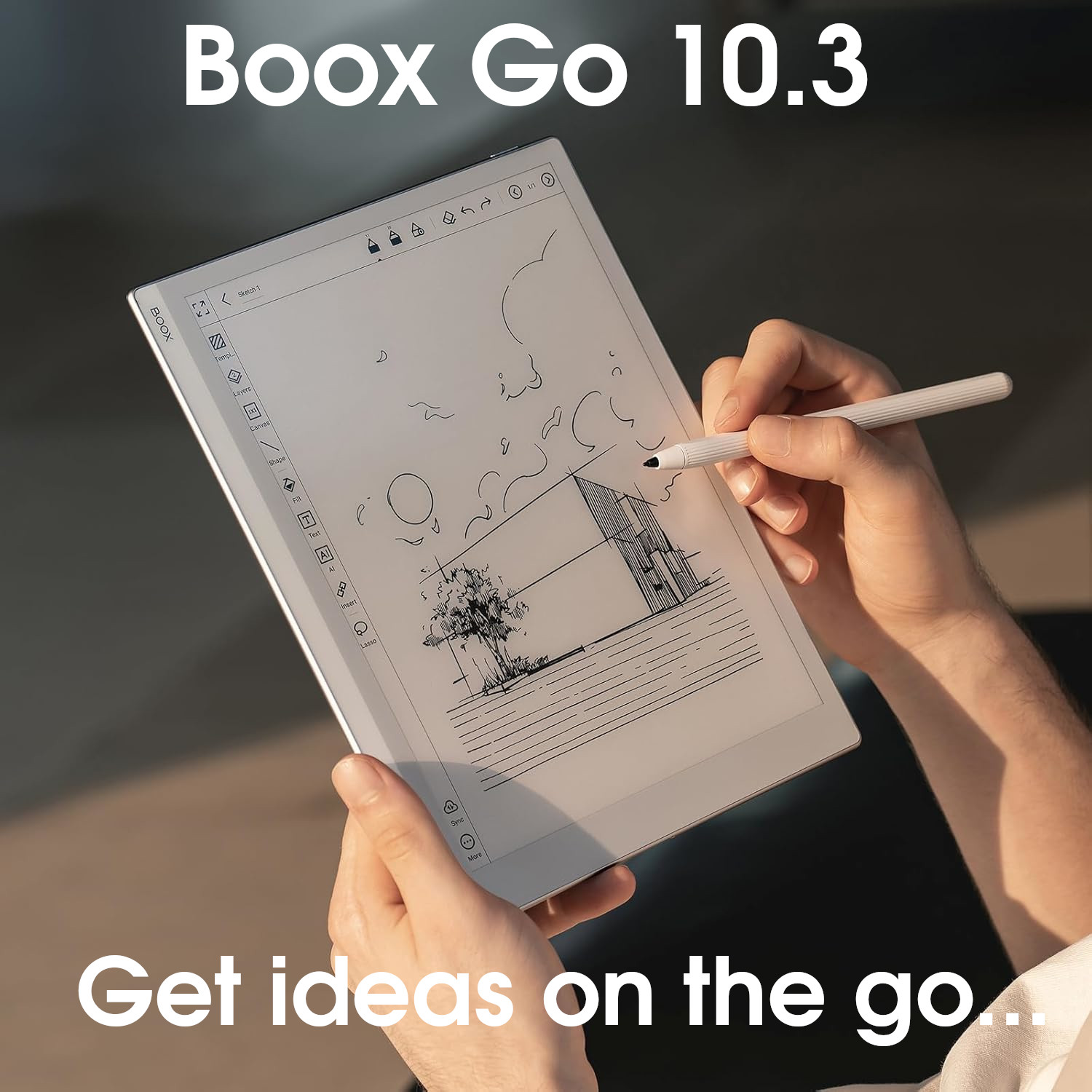
As mentioned previously, you can get e-ink devices with larger screens 10″-13″ (approximately A5-sized to A4-sized) but these generally fall into the category of e-ink tablets (with handwriting support via a stylus). The majority of this website (eWritable) is dedicated to e-ink tablets, so I won’t discuss them here in the e-reader area, but if note-taking is something you’re interested in, perhaps check out my ‘Best E-Ink Tablets’ article .
Ultimately, choosing the right screen size involves weighing portability against viewing area. Smaller devices excel in convenience and ease of handling, making them ideal for reading on the move, while larger screens provide a more generous, comfortable visual environment at the expense of compactness. The best choice depends on where and how one reads, and the extent to which one prioritises mobility over spaciousness.
Screen Technology
At the heart of every e-reader lies its screen technology, which exerts a profound influence on visual comfort, legibility, and overall reading quality. Most modern devices employ variants of E-Ink, a reflective display technology designed to emulate the optical qualities of printed paper. Unlike emissive screens found on tablets and smartphones, E Ink panels rely on ambient light, rendering text by rearranging microcapsules of pigment rather than by projecting illumination into the eyes. This produces a markedly gentler reading experience, reduces visual fatigue, and offers excellent clarity even under direct sunlight.
The most widely used generation is E-Ink Carta, a technology characterised by high contrast, low power consumption, and crisp text rendering. Newer iterations (such as Carta 1200 and Carta 1300) introduce incremental improvements, including faster refresh rates, slightly deeper blacks, and marginally brighter whites. These refinements may seem subtle, but they contribute to smoother page turns and more stable rendering, particularly in interfaces that rely on partial refreshes to minimise flicker. While the differences between generations are not always immediately perceptible to casual readers, those accustomed to prolonged or intensive reading often appreciate the heightened clarity and responsiveness. Inherently, Carta is a monochrome screen technology, supporting blacks, whites and shades of grey in between (but not colour), which in most use cases is perfectly fine for reading text.
In addition to monochrome displays, an increasing number of e-readers now incorporate colour E Ink, most commonly via the Kaleido 3 technology. Colour E Ink overlays a colour filter array atop a standard black-and-white Carta panel, enabling the display of muted but serviceable hues. These screens are not intended to rival the vibrancy of LCD or OLED panels; rather, they provide enough chromatic differentiation to enhance comics, children’s books, annotated materials, and organisational elements such as highlights or tags. The trade-off is reduced brightness and contrast compared with monochrome panels, as well as a slight softness in text rendering due to the presence of the colour layer. For readers whose libraries consist chiefly of prose, monochrome Carta screens remain superior; for those who value visual classification or occasional illustrated works, colour E Ink offers a meaningful, if specialist, advantage.
Another consideration is refresh performance, which pertains to how quickly and cleanly the screen can update its content. Because E Ink relies on physically moving charged particles, refresh rates are inherently slower than those of traditional displays. Manufacturers mitigate this through various software techniques, such as partial refresh modes, which update only the areas of the screen that change. These modes help reduce full-screen flashes but can occasionally introduce ghosting – faint remnants of previous text. Higher-end screens and more advanced controllers tend to handle these transitions more gracefully, resulting in a smoother and more stable reading experience.
Some Android e-readers support super-fast refresh rates, based on proprietary hardware/software, which improves the performance of third-party apps on e-ink screens (particularly those that have a lot of on-screen movement), as well as giving the user more control and configuration of the refresh rates used for particular apps. The trade-off is that this technology often drains the battery much faster.
Taken together, screen technology determines the fundamental character of an e-reader: its clarity, its responsiveness, and the ease with which one can read for hours without strain. Understanding the nuances of E Ink – its strengths, its limitations, and its evolving forms – empowers readers to select a device whose visual qualities align with their personal habits, preferences, and reading environments.
Front-Lighting Systems
Nearly all modern e-readers are equipped with a front-lighting system, in which LEDs project light across the surface of the display rather than shining directly into the reader’s eyes. This preserves the paper-like character of E Ink while enabling comfortable reading in dim or fully dark environments. Most contemporary devices also include a warm-light option, allowing the user to adjust the colour temperature from cool white to amber tones. This feature is especially valued for evening reading, as warmer hues can feel gentler and less stimulating. Although implementation varies slightly across manufacturers, the presence of both front-light and warm-light illumination has become a standard expectation, and differences between devices tend to relate more to subtle refinements, such as uniformity and gradation, than to fundamental capability.
Ergonomics and Physical Design
The ergonomics of an e-reader – the way it fits in the hand, the distribution of its weight, and the tactile qualities of its materials – can play a crucial role in determining long-term comfort. Even small variations in thickness, bezel design, or texture can markedly influence how the device feels during extended reading sessions. Slimmer and lighter models are often favoured for their effortless portability and ease of one-handed use, yet devices with slightly more substantial bodies can provide a steadier, more grounded hold, reducing strain during prolonged periods of reading.
Physical page-turn buttons, once a common feature and now revived on several modern devices, offer an alternative to touch-based navigation. Many readers find them gratifyingly tactile and ergonomically advantageous, particularly when reading one-handed or in positions where screen taps are less convenient. Their inclusion or absence can significantly shape the character of a device, even when the underlying hardware remains similar.
Bezel width also contributes to ergonomic experience. Narrow bezels maximise screen area but may leave little room for a comfortable grip, while wider bezels – especially on asymmetrical “candy-bar” designs -provide a natural resting place for the thumb. The back of the device, whether smooth, textured, or softly rubberised, further affects stability in the hand and resistance to slipping.
Ultimately, physical design is as much about feel as it is about measurable specifications. Two devices with identical weights and dimensions can nevertheless convey different sensations of balance, solidity, or delicacy. Prospective buyers should therefore consider not only the numerical attributes of a device but also the subtler, more subjective qualities that determine how inviting it is to hold and use over time. Over the next few months, I will hopefully be reviewing several e-readers and will explore the ergonomics of each device.
Battery Life
Battery performance remains one of the most distinctive strengths of dedicated e-readers, owing largely to the extraordinary efficiency of E Ink technology. Because these displays consume power only when refreshing the page rather than during static viewing, many devices are capable of operating for weeks on a single charge under typical reading conditions. Actual longevity, however, varies widely depending on factors such as screen size, front-light brightness, wireless connectivity, processor demands, and (particularly in the case of Android-based models) super-refresh technology and the behaviour of background applications.
Manufacturers’ claims can be somewhat idealised, often based on narrowly defined usage patterns that do not always reflect real-world habits. For this reason, assessing true battery endurance can be challenging.
In the coming months, I intend to conduct systematic battery testing across a wide range of devices, using controlled and repeatable conditions to build a comparative database of typical operating times. This should help establish clearer expectations for prospective buyers, offering a more empirical foundation than the often optimistic figures supplied in marketing materials. Until then, readers should regard manufacturer estimates as broad indicators rather than definitive guarantees, and consider how their own reading behaviour may influence battery longevity.
Additional Hardware Features
Beyond screen quality, ergonomics, and core performance, many e-readers incorporate a variety of supplementary hardware features that enhance convenience or expand their functional scope. One of the increasingly common additions is Bluetooth audio, which enables wireless pairing with headphones or speakers for audiobook playback. Kindle and Kobo devices lean heavily into this capability (primarily to promote their own audiobook libraries), and Android-based e-readers often follow suit, whereas other ecosystems adopt it more selectively. For readers who alternate fluidly between listening and reading, this integration can be genuinely useful; for others, it remains a peripheral, if pleasant, enhancement.
Some e-readers also include built-in speakers, allowing audiobooks or text-to-speech playback without external accessories. While audio quality tends to be modest due to the constraints of slim enclosures, integrated speakers can be convenient for quick listening or casual use. Microphones, though rarer, appear on certain Android-based models and support voice notes, app-specific functions, or simple dictation. These features broaden the device’s utility but are not typically central to the reading experience.
Waterproofing has become a particularly valued feature, with many mid-range and premium devices achieving IPX7 or IPX8 ratings. This offers practical protection against accidental immersion or splashes, making e-readers more resilient companions for reading in the bath, by the pool, or outdoors. While not essential for all users, waterproofing provides a reassuring buffer against mishaps and enhances the device’s durability.
Another convenience found on select models is wireless charging, which simplifies everyday use by eliminating the need to plug in a cable. The feature is not widespread, but where implemented it reflects a move toward more seamless, modernised hardware design. Wireless charging is functionally identical to traditional charging but favours ease over longevity, as it allows the device to be topped up casually throughout the day.
Although increasingly uncommon, microSD expansion remains available on a handful of devices. This allows readers to augment internal storage significantly and at minimal cost – an advantage for those with large collections of PDFs, comics, or audiobooks. The broader industry shift away from expandable storage reflects a preference for cloud-based libraries and streamlined internal layouts, but microSD support still offers tangible benefits for certain workflows.
Some e-readers also incorporate sensors, such as G-sensors for automatic screen rotation or ambient light sensors that modulate front-light brightness based on environmental conditions. These refinements do not alter the fundamental reading experience, but they contribute to a smoother, more adaptive interface by reducing the need for manual adjustments.
Taken together, these additional hardware features serve to differentiate devices not by transforming their essential purpose but by modulating the texture of everyday use. Whether through enhanced durability, expanded audio capabilities, simplified charging, or greater storage flexibility, each feature contributes its own subtle value. For most readers, these additions are conveniences rather than necessities, but for some, they may represent decisive qualities that align a device more closely with personal habits and preferences.
Storage & Performance
In most dedicated e-readers, storage capacity is seldom a critical constraint. Even modest configurations, such as the common 8 GB found in many entry-level models, can accommodate several thousand eBooks, given the typically minute file sizes of reflowable formats like EPUB. Moreover, the increasing prevalence of cloud-based library management further diminishes the urgency of large local storage, allowing readers to keep their full collections synchronised online while downloading only the titles they are actively reading. Larger capacities may be useful for those who maintain extensive PDF archives or who use devices with audio capabilities, but for the majority of readers, storage is a relatively low-priority specification.
Similarly, CPU performance is not generally a decisive factor for traditional e-readers. The task of rendering text, refreshing pages, and managing a library of lightweight files places minimal demands on processing hardware. As a result, even devices with decidedly modest chipsets tend to feel perfectly adequate for the core purpose of sequential reading.
Performance considerations become more salient primarily in the realm of Android-based e-readers, where users may run multiple third-party applications, annotate complex PDFs, or multitask in ways that exceed the scope of typical e-reader usage. In those contexts, faster processors and increased RAM can contribute to smoother navigation and reduced latency; however, such requirements remain specific to more advanced or app-driven workflows rather than the basic act of reading.
For most readers, then, storage and processing power should be viewed as supporting features rather than central determinants of overall quality. A well-calibrated E Ink display, comfortable ergonomics, and a coherent software environment will exert far greater influence on the day-to-day experience than incremental differences in gigabytes or processor cycles.
Summary
Selecting an e-reader is ultimately an exercise in aligning one’s personal reading habits, technical preferences, and long-term expectations with the strengths and constraints of a particular device and ecosystem.
Although e-readers may appear superficially similar, the underlying differences in file format support, DRM systems, ecosystem openness, and hardware design shape how flexible, comfortable, and future-proof a device will feel in everyday use.
Understanding eBook file formats and their respective behaviours provides the conceptual foundation for any informed decision. EPUB remains the most versatile and widely supported standard outside Amazon’s proprietary environment, while PDFs retain their relevance for complex, fixed-layout documents. DRM, meanwhile, exerts a quiet but profound influence on digital ownership: Kindle’s system prioritises integration at the cost of portability, whereas Adobe DRM offers a more interoperable, if occasionally cumbersome, alternative. DRM-free content represents the closest digital analogue to true ownership, granting readers complete autonomy over their libraries.
The ecosystem in which a device operates is equally significant. Amazon’s Kindle platform offers a polished, frictionless experience but encourages deep entanglement with its proprietary formats. Kobo embraces openness and typographic flexibility, making it well suited to readers who value choice and customisation. Android-based e-readers occupy yet another niche, appealing to those who desire maximal configurability and cross-platform freedom, even at the cost of greater complexity.
On the hardware side, considerations such as screen size, display technology, front-lighting, ergonomics, and battery life play tangible roles in determining everyday comfort. Smaller screens favour portability, while larger ones offer a more expansive, restful visual field. Modern E Ink panels deliver high contrast and low power consumption, and the widespread adoption of adjustable front-lighting ensures readability in all environments. Battery life remains a major strength of E Ink devices, though actual endurance varies with usage patterns – a subject this guide will continue to investigate through systematic testing.
Additional hardware features(Bluetooth audio, waterproofing, wireless charging, microSD expansion, speakers, microphones, and various sensors) serve as refinements rather than essentials, enriching the experience where they align with individual needs. For many users, these elements constitute subtle enhancements; for others, they may decisively shape the suitability of a given device.
In aggregate, the modern e-reader market offers a diversity of approaches rather than a single optimal solution. The best device for any individual depends not on abstract specifications but on the interplay between ecosystem, hardware, and personal reading style. By examining these factors with clarity and nuance, readers can navigate the landscape with confidence, selecting an e-reader that not only satisfies immediate expectations but also supports a sustained, rewarding engagement with digital literature.
I hope this Buying Guide has been helpful to you – your next step might be to check out my interactive e-reader comparison table to whittle down which models meet your needs the best.